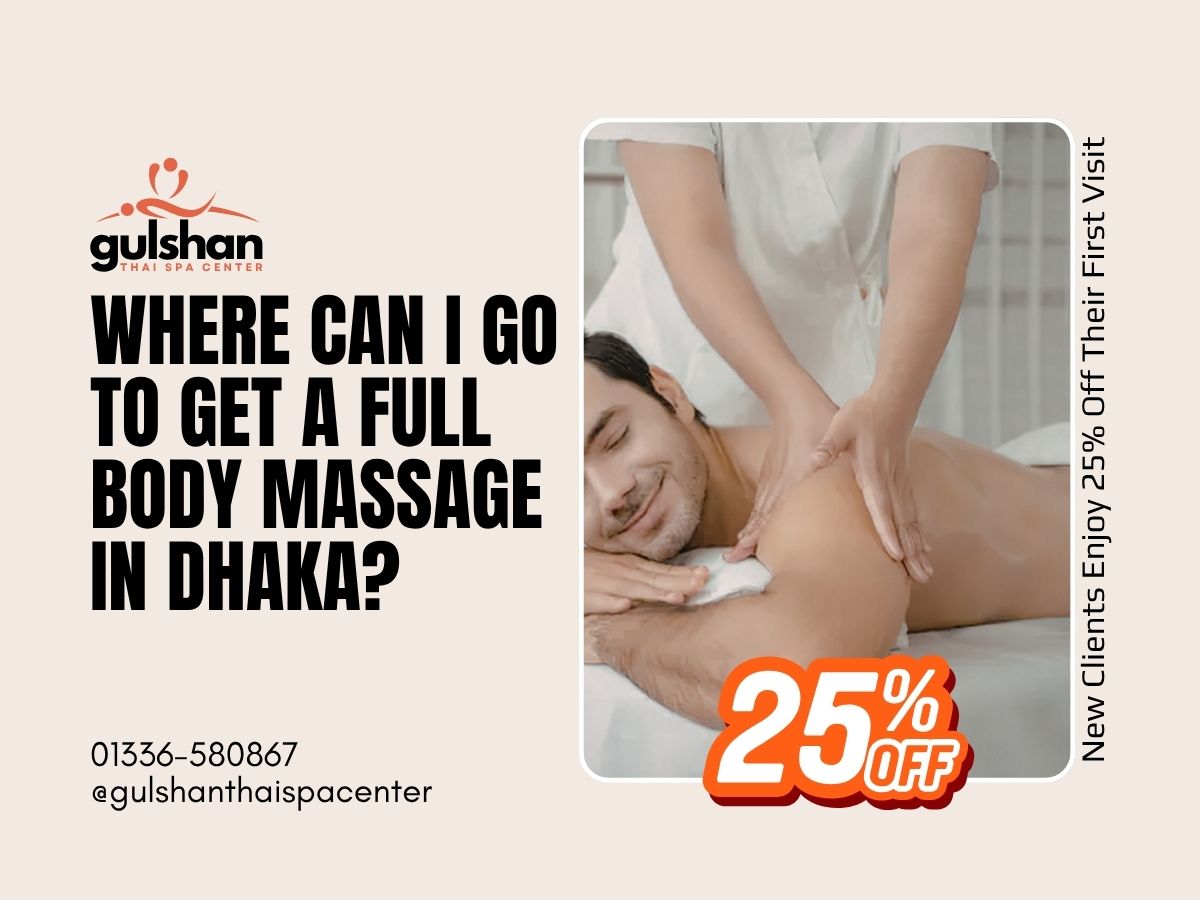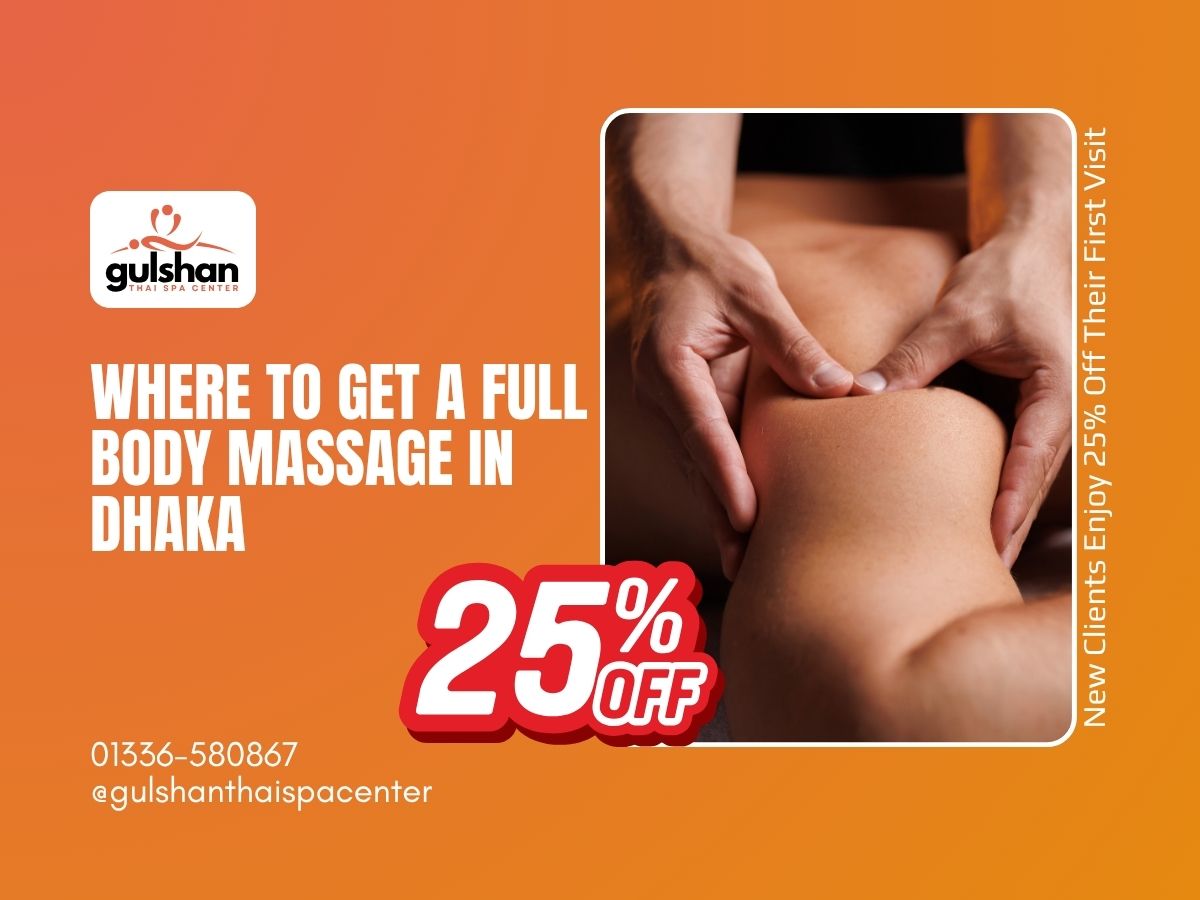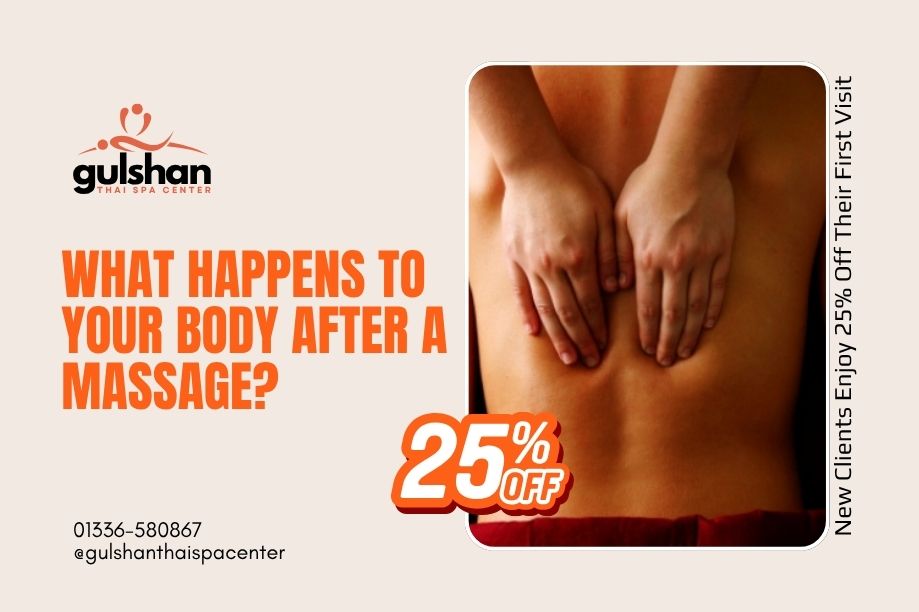
There’s something genuinely powerful about knowing how to use your hands to help someone feel better. Whether you want to help a partner unwind after a stressful week, support a friend recovering from muscle soreness, or simply learn what professional therapists actually do — understanding how to give a full body massage is a skill worth developing.
However, it’s also worth being upfront about something: there’s a significant difference between a well-meaning home massage and what a certified massage therapist delivers. Throughout this guide, you’ll learn proper techniques, correct sequences, and safe practices. At the same time, you’ll understand clearly when a professional session is the better — and safer — choice.
If you’re in Dhaka and ready to experience a truly professional full body massage, Gulshan Thai SPA Center in Gulshan 2 is where over 2,000 clients have found exactly that — rated 4.9★ and open daily from 10:00 AM to 10:00 PM.
New clients receive 25% off their first visit. Call 01336-580867 to book.
What Is a Full Body Massage? (Before You Begin)
Before learning how to give a full body massage, it helps to understand what a complete session actually involves.
A full body massage is a structured therapeutic treatment that addresses all major muscle groups across the entire body. A proper session typically covers the back, neck, shoulders, arms, hands, glutes, legs, and feet — following a specific sequence that allows the body to progressively relax from one region to the next.
The Core Goals of a Full Body Massage
A well-executed full body massage achieves several things simultaneously:
- Releases physical tension held in the muscles
- Improves blood circulation throughout the body
- Stimulates the lymphatic system to support natural detoxification
- Activates the parasympathetic nervous system, reducing stress hormones
- Eases joint stiffness and improves range of motion
- Creates a genuine sense of mental calm and physical restoration
How Long Should a Full Body Massage Take?
A proper full body massage routine should take a minimum of 60 minutes. A 90-minute session is more appropriate for comprehensive coverage. A 30-minute session can address specific areas but doesn’t constitute a true full body treatment. Professional therapists at Gulshan Thai SPA Center typically recommend 60 to 90-minute sessions for the best therapeutic results.
What You Need Before You Start
Setting Up the Environment
The environment matters more than most beginners realise. Therefore, before you begin, take a few minutes to prepare the space properly:
- Surface: A firm, padded surface is essential. A professional massage table is ideal, but a thick yoga mat or folded blankets on the floor works reasonably well at home. A soft mattress, however, provides too little resistance for effective technique.
- Temperature: The room should be comfortably warm — around 24–26°C. Cold muscles tighten rather than relax, which works directly against your goals.
- Lighting: Dim the lights or use soft lamp lighting. Harsh overhead lighting keeps the nervous system alert rather than calm.
- Sound: Soft background music at a low volume — nature sounds, ambient tracks, or gentle instrumental music – meaningfully supports relaxation.
- Towels and draping: Clean towels are essential for professional draping. Only the area being worked on should be uncovered at any time. This is a non-negotiable standard, both for comfort and for maintaining trust.
Choosing the Best Oil for Full Body Massage
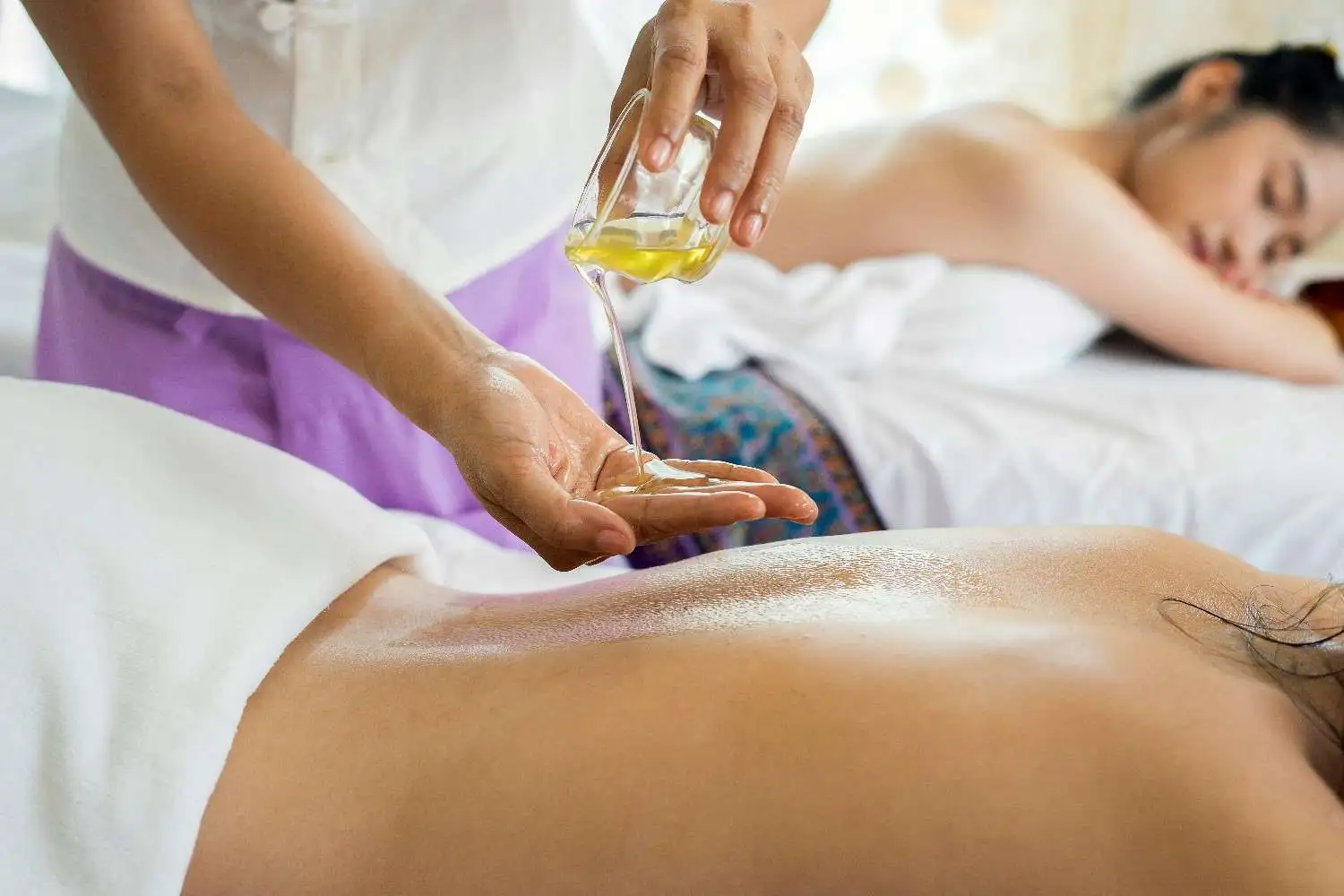
Using the right oil is fundamental to good massage technique. Oil reduces friction between your hands and the skin, allowing strokes to flow smoothly rather than drag. Here are the most effective options:
- Coconut oil — Widely available, skin-friendly, and has a light, neutral scent. One of the best all-round choices for a full body massage at home.
- Sweet almond oil — Lightweight, absorbs gradually, and is suitable for most skin types. Commonly used by professional therapists.
- Jojoba oil — Technically a wax rather than an oil, it closely mimics the skin’s natural sebum. Excellent for sensitive skin.
- Lavender essential oil (diluted) — A few drops added to a carrier oil like coconut or almond significantly enhances the relaxation effect. Never apply undiluted essential oils directly to skin.
- Warm oil — Gently warming your massage oil before use makes a noticeable difference to muscle relaxation. Place the oil bottle in a bowl of warm water for a few minutes before starting.
Always perform a small patch test before using any oil on a new person, particularly those with sensitive skin or nut .
Full Body Massage Sequence: The Correct Order
One of the most important things to understand when learning how to give a full body massage is that sequence matters. Professional therapists follow a structured order that allows each body region to progressively warm up and relax before moving to the next.
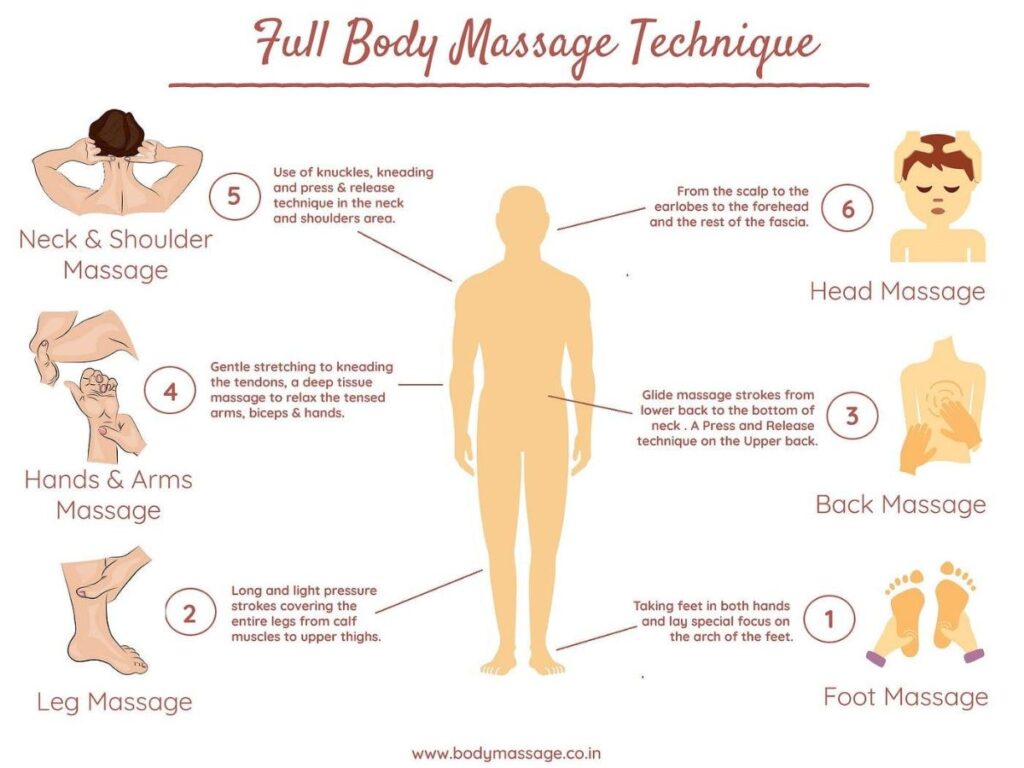
The standard full body massage sequence order is:
- Back (upper, mid, lower)
- Glutes and hips
- Back of legs
- Feet
- (Person turns over)
- Front of legs
- Abdomen (optional, with consent)
- Arms and hands
- Neck and shoulders
- Scalp and face (optional)
This sequence follows the principle of working from large muscle groups to smaller ones, and from the core outward — which is how professional Swedish and Thai massage techniques are structured.
How to Give a Full Body Massage: Step-by-Step
Step 1: Opening Strokes – Effleurage
Before working on any specific area, begin every region with effleurage — long, slow, gliding strokes that warm the tissue and signal to the body that relaxation is beginning.
Use the flat of both palms, applying light to medium pressure. Move slowly and deliberately. These opening strokes should feel continuous and unhurried, because the nervous system responds to rhythm and predictability by releasing tension. Start at the lower back and glide upward toward the shoulders, then sweep back down the sides of the torso.
Spend at least 2–3 minutes on opening strokes before applying any deeper pressure.
Step 2: How to Massage the Back Properly
The back is typically where the most tension accumulates, so it deserves the most time and attention in a full body massage routine.
Technique – Petrissage (kneading): After opening strokes, move into petrissage. Use your thumbs and the heels of your hands to knead the muscle tissue alongside the spine never directly on the spine itself. Work the erector spinae muscles that run parallel to the vertebrae, using circular thumb pressure moving upward from the lower back to the base of the neck.
Technique – Friction: For areas of specific tension, apply small, deep circular movements using your thumbs. The upper trapezius (between the neck and shoulders) and the area just above the sacrum (the triangular bone at the base of the spine) are the most common sites of chronic tension.
Key points to avoid:
- Never apply direct downward pressure on the spine
- Avoid deep pressure directly over the kidneys (mid-lower back)
- Reduce pressure near any bony prominences
Step 3: How to Massage Neck and Shoulders
The neck and shoulders hold an enormous amount of postural tension, particularly in people who work at desks or spend long hours on their phones.
With your fingertips, apply gentle circular pressure along the base of the skull (the occipital ridge) moving outward toward the ears. Then, using your thumbs, work down either side of the cervical spine with slow, deliberate pressure. Never apply rapid or forceful movements to the neck.
For the shoulders, use both hands to compress and knead the trapezius muscle — the large muscle that runs from the base of the skull across the top of the shoulders. Use your thumb pads to find and hold areas of localised tension (trigger points) for 20–30 seconds before releasing.
Safety note: The neck contains major blood vessels and nerve pathways. Therefore, avoid deep pressure, sudden movements, or any rotation techniques in this area unless you are a certified therapist.
Step 4: How to Massage the Glutes and Hips
The gluteal muscles are among the largest in the body and frequently hold tension that contributes directly to lower back pain. However, this area requires explicit consent and careful draping at all times.
Use the heel of your palm or your knuckles to apply broad, circular pressure across the gluteus maximus muscle. Work outward from the sacrum toward the hip joint. Deep pressure here can significantly relieve referred tension in the lower back and down the leg.
Step 5: How to Massage Legs and Feet
Back of the legs: Begin with effleurage strokes from the ankle upward toward the hip, following the direction of venous blood flow back toward the heart. After warming the tissue, use petrissage to knead the hamstrings (back of the thigh) and calf muscles. The calf, in particular, tends to hold significant tension and responds well to firm, sustained thumb pressure along the muscle belly.
Feet: Turn full attention to the feet before asking the person to turn over. Apply firm thumb pressure along the arch of the foot, working from the heel toward the ball. Use your knuckles to apply broad pressure across the sole. Pay attention to the Achilles tendon and the muscles of the heel.
Many people find foot massage deeply relaxing — often more so than any other body part — because of the high concentration of nerve endings in this area.
Front of the legs: After the person turns over, work the quadriceps (front of the thigh) with broad petrissage strokes, and the tibialis anterior (shin muscle) with gentle longitudinal pressure. Be lighter here than on the back of the legs, as the tissue is thinner and more sensitive.
Step 6: How to Massage Arms and Hands
Starting at the wrist, use effleurage strokes moving up the forearm toward the elbow, then continuing to the shoulder. Apply petrissage to the forearm flexors and extensors, and gentle compression along the bicep and tricep.
For the hands, use your thumbs to apply pressure to the palm, working from the centre outward. Gently mobilise each finger individually by holding it at the base and applying gentle traction. The hands accumulate significant tension in people who type, drive, or use their hands repetitively — and this part of the massage is often deeply appreciated.
Step 7: How to Massage the Scalp
Scalp massage is optional but extremely effective for relieving tension headaches and promoting genuine mental relaxation.
Use all ten fingertips to apply small, circular movements across the entire scalp, moving from the hairline backward toward the base of the skull. Apply firm but comfortable pressure. The goal is to move the scalp tissue against the underlying skull rather than simply rubbing the hair.
Spend 3–5 minutes on the scalp. For many people, this part of the session produces the deepest sense of relaxation.
Step 8: Closing Strokes
End the massage the same way you began it — with slow, light effleurage strokes moving across the entire back and down the limbs. These closing strokes signal to the nervous system that the session is complete, and give the body time to integrate the work that’s been done.
Allow the person to rest quietly for at least 5–10 minutes after the session before moving or getting up.
Full Body Massage Techniques: A Quick Reference Guide
| Technique | Description | Best Used For |
|---|---|---|
| Effleurage | Long, gliding strokes with flat palms | Opening, closing, warming tissue |
| Petrissage | Kneading and lifting of muscle tissue | Breaking up tension, back and legs |
| Friction | Deep circular pressure with thumbs | Trigger points, chronic knots |
| Tapotement | Rhythmic tapping or cupping | Stimulation, sports recovery |
| Compression | Sustained palm pressure | Large muscle groups, glutes |
| Vibration | Rapid shaking of the tissue | Nerve endings, relaxation |
How to Give a Full Body Massage to Your Partner
Giving a massage to your partner at home is one of the most genuinely caring things you can do for their wellbeing. Beyond the physical benefits, the act itself communicates care, attention, and presence in a way that words often can’t.
That said, here are a few things that make a real difference:
Ask before you begin. Find out if there are any areas that are sore, tender, or that they’d prefer you avoid. This small step builds trust and ensures comfort throughout.
Check in regularly. Ask about pressure periodically — not constantly, as that disrupts the flow, but enough to ensure comfort. Pressure that feels fine at the start of a session can feel too intense as the session progresses.
Keep it consistent. One of the most common mistakes beginners make is varying their speed and pressure unpredictably. Consistent rhythm is what allows the nervous system to relax.
Focus on their response. Watch for signs of tension — a held breath, a flinch, tightened muscles. These are signals to ease the pressure immediately.
Don’t rush. A meaningful partner massage at home should take at least 30 to 45 minutes. A rushed session of 10 minutes achieves very little therapeutically and can feel dismissive rather than caring.
How to Give a Relaxing Full Body Massage: The Atmosphere Matters
The difference between a massage that genuinely relaxes and one that simply applies pressure often comes down entirely to atmosphere. Professional spas like Gulshan Thai SPA Center invest significantly in the environment and for good reason.
At home, you can recreate a spa-like experience with these practical steps:
- Scent: Diffuse lavender, eucalyptus, or chamomile essential oil in the room 15–20 minutes before the session.
- Sound: Use a dedicated relaxation playlist rather than regular music with lyrics and varying tempo.
- Temperature: Ensure the room is warm enough that the person doesn’t feel cold when undraped.
- Phone: Both you and the person receiving the massage should switch phones to silent. Interruptions break the parasympathetic state that makes massage therapeutically effective.
- Time: Don’t schedule a massage when either of you is in a hurry. The psychological pressure of time limits directly counteracts the physical relaxation benefits.
Massage Techniques by Style: Thai, Swedish, Deep Tissue
How to Give a Thai Full Body Massage
Traditional Thai massage is fundamentally different from Western styles. Rather than using oil and gliding strokes, Thai massage uses rhythmic compression, acupressure on specific energy lines (called Sen lines), and assisted stretching. The recipient remains clothed in comfortable, loose-fitting clothing throughout.
A basic Thai massage sequence involves working from the feet upward, applying palm pressure along the inner leg lines, then progressively moving up the body with compression and stretching. Because Thai massage involves joint mobilisation and assisted postures, it carries a higher risk of injury in untrained hands. Therefore, learning from a certified Thai massage practitioner before attempting these techniques is strongly recommended.
How to Do a Swedish Full Body Massage
Swedish massage is the most accessible style for beginners because it relies on the same core techniques described in this guide — effleurage, petrissage, friction, and tapotement. The defining principles of Swedish massage are moderate pressure, long connecting strokes, and a flowing, rhythmic quality throughout the session.
Deep Tissue Massage Techniques at Home
Deep tissue massage targets the deeper layers of muscle and fascia. It uses slower strokes and more concentrated pressure than Swedish massage. However, it requires a solid understanding of anatomy to be applied safely. Applying uninformed deep pressure over nerves, blood vessels, or joints can cause genuine injury. For this reason, deep tissue work beyond basic trigger point compression is better left to certified therapists.
Full Body Massage Pressure Points: What Beginners Should Know
Pressure points or acupressure points in Traditional Chinese and Thai medicine — are specific locations on the body where concentrated pressure can relieve tension, reduce pain, and support overall wellness.
Some of the most accessible and safe pressure points for home massage include:
- GB 21 (Jian Jing) — Top of the shoulder, midway between the neck and the tip of the shoulder. Relieves shoulder and neck tension. Apply firm thumb pressure for 20–30 seconds.
- LI 4 (He Gu) — The webbing between the thumb and index finger. Relieves headaches and upper body tension.
- BL 10 — Base of the skull on either side of the spine. Relieves occipital headaches and neck stiffness.
- KD 1 (Yong Quan) — Centre of the sole of the foot. A deeply grounding point that promotes relaxation and reduces anxiety.
Avoid pressure points during pregnancy without professional guidance. Certain points are contraindicated and can stimulate uterine contractions.
Full Body Massage Safety: Dos and Don’ts
Safe Massage Practices
- Always warm up the tissue with effleurage before applying deep pressure
- Keep all movements slow and deliberate — speed creates friction, not relaxation
- Maintain proper body mechanics to protect your own back and wrists
- Use clean towels and fresh oil for every session
- Ask for feedback regularly and respond immediately to discomfort
What to Avoid
- Never apply direct pressure on the spine, joints, or bony areas
- Avoid deep pressure on the back of the knees, where major blood vessels run close to the surface
- Do not massage directly over bruises, open wounds, skin infections, or inflamed tissue
- Avoid deep abdominal massage without specific training
- Never massage someone with a fever, a blood clotting disorder, active cancer, or recent surgery
Who Should Not Get a Full Body Massage at Home
Some conditions require professional assessment before any massage is appropriate:
- Recent fractures or sprains
- Deep vein thrombosis (DVT) or blood clotting conditions
- Osteoporosis (requires significantly modified technique)
- Pregnancy (particularly the first trimester)
- Active skin conditions, infections, or rashes
- Uncontrolled high blood pressure or cardiovascular conditions
If any of these apply, the appropriate step is to consult a physician first and then seek a certified massage therapist who is trained to work with complex presentations.
When to Skip the Home Massage and See a Professional
Learning how to give a full body massage at home is genuinely valuable. However, there are situations where a home massage however well-intentioned simply isn’t enough.
You should see a professional therapist when:
- The person has chronic, recurring pain that hasn’t improved with basic massage
- There’s significant postural dysfunction or suspected muscular imbalance
- You’re dealing with sports injuries or post-exercise muscle damage
- Stress and anxiety levels are significantly affecting daily life and sleep
- You want the full therapeutic benefit that only trained technique, professional equipment, and a proper clinical environment can deliver
In these cases, a certified therapist brings anatomical knowledge, years of trained technique, and professional-grade tools that a home session simply cannot replicate.
Why Choose Gulshan Thai SPA Center for a Professional Full Body Massage in Dhaka?
Reading about how to give a full body massage is genuinely useful. But experiencing one delivered by a certified, experienced professional is something else entirely.
At Gulshan Thai SPA Center in Gulshan 2, Dhaka, every single element you’ve read about in this guide — proper technique, correct sequence, therapeutic pressure, professional oils, private hygienic rooms, and trained hands — is delivered consistently, session after session.
Here’s why over 2,000 clients have rated us 4.9★:
- ✅ Certified therapists trained in Thai, Swedish, Deep Tissue, Aromatherapy, and Hot Stone techniques
- ✅ Private, clean treatment rooms — every session, every client
- ✅ Professional-grade oils and materials — no compromises on quality
- ✅ Personalised sessions — every therapist conducts an intake before starting
- ✅ Transparent pricing — you know what you’re paying before you arrive
- ✅ 7 massage modalities — Traditional Thai, Swedish, Deep Tissue, Aromatherapy, Hot Stone, B2B, and Full Body Scrub
- ✅ Serving all of Dhaka — Gulshan 1 & 2, Banani, Baridhara, Uttara, Dhanmondi, and beyond
- ✅ Open daily 10:00 AM – 10:00 PM — walk-ins welcome, 24/7 booking available
🎁 New clients receive 25% off their first visit. No voucher needed — just mention it when you call or arrive.
📞 Book now: 01336-580867 🌐 gulshanthaispacenter.com
Frequently Asked Questions (FAQs)
Start with slow effleurage (gliding) strokes on the back using warmed oil. Work from the lower back upward toward the shoulders. Spend 2–3 minutes on these opening strokes before applying any deeper pressure. Always ask for feedback and begin with lighter pressure than you think is needed.
The standard full body massage sequence is: back → glutes → back of legs → feet → (person turns over) → front of legs → abdomen (optional) → arms and hands → neck and shoulders → scalp. This order follows the principle of working large muscle groups before smaller ones.
A proper full body massage at home should take a minimum of 60 minutes to cover all major muscle groups adequately. A 90-minute session allows more time in areas of significant tension. A 30-minute session is better suited to targeting one or two specific areas rather than a complete full body routine.
Coconut oil and sweet almond oil are the two most practical and effective choices for home use. Both are widely available, skin-friendly, and provide the right level of slip for smooth technique. Warming the oil slightly before use significantly improves the experience.
How much pressure should I use during a full body massage?
Begin with lighter pressure than you think is necessary and increase gradually based on feedback. A general rule is that pressure should feel like a “good discomfort” — firm enough to be felt in the tissue, but never sharp, burning, or painful. Always ease off immediately if the person reacts with tension, a held breath, or discomfort.
Is it safe to give a deep tissue massage at home?
Basic trigger point compression and firm petrissage are generally safe for home use when applied on major muscle groups away from joints, nerves, and blood vessels. However, true deep tissue techniques — particularly around the spine, neck, or joints — carry a real risk of injury without proper training. For chronic pain or specific muscle conditions, a certified deep tissue therapist is strongly recommended.
Where can I get a professional full body massage in Dhaka?
Gulshan Thai SPA Center in Gulshan 2, Dhaka offers professional full body massage by certified therapists. Rated 4.9★ by 2,000+ clients, with services including Thai, Swedish, Deep Tissue, Aromatherapy, and Hot Stone massage. Open daily 10:00 AM – 10:00 PM. New clients receive 25% off their first visit. Call: 01336-580867.
Final Thoughts: Home Technique Is a Starting Point – Professional Care Is the Destination
Learning how to give a full body massage is genuinely worthwhile. It deepens your understanding of the body, develops a valuable skill, and can meaningfully improve the wellbeing of the people you care about.
However, the honest truth is that what you learn from a guide — however detailed — is the foundation, not the full picture. Certified therapists train for years to develop the anatomical knowledge, pressure sensitivity, and technical precision that make a professional full body massage genuinely therapeutic rather than simply pleasant.
If you’re in Dhaka and you want to experience what a truly professional full body massage feels like — or if you have chronic tension, persistent pain, or significant stress that home techniques haven’t been able to address — Gulshan Thai SPA Center is ready to help.
Call 01336-580867. Book your session today. New clients receive 25% off their first visit.
📍 Gulshan 2, Dhaka | 🌐 gulshanthaispacenter.com Open Daily: 10:00 AM – 10:00 PM | Walk-ins Welcome | 24/7 Booking Available