If your shoulders live somewhere up near your ears, if you’ve started dreaming about your commute, or if you just can’t remember the last time your body felt loose and unhurried — you’re exactly who this guide is for. Thai massage has quietly become one of the most requested treatments in Gulshan, and once you understand what it actually does to a tired body, it’s easy to see why.
At Gulshan Thai SPA Center, we’ve spent years watching first-time clients walk in stiff and skeptical and walk out asking when they can book their next session. This guide walks you through everything — what Thai massage is, how it differs from other massage styles, what actually happens during a session, and exactly what to expect from arrival to that loose, floaty feeling you’ll carry home with you.
What is Thai Massage?
Thai massage — sometimes called “Nuad Thai” or Thai yoga massage — is a full-body therapy that blends acupressure, assisted stretching, and rhythmic compression. Unlike a typical oil massage where you lie still while the therapist works on you, Thai massage is interactive. Your therapist gently guides your limbs through yoga-like stretches, applies palm and thumb pressure along energy lines, and uses controlled body weight (sometimes their own knees, feet, or forearms) to release tension that’s been sitting in your muscles for weeks, maybe months.
It’s performed on a padded mat or a firm table, and — this surprises a lot of first-timers — it’s done fully clothed, using loose, breathable garments provided by the spa. There’s no oil required, though many Gulshan clients like to combine their Thai massage with a light oil finish for extra glide and relaxation.
The result is a treatment that feels part massage, part deep stretch, part meditation. You leave taller, looser, and noticeably calmer.
Health Benefits of Thai Massage
The appeal of traditional Thai massage isn’t just that it feels good in the moment — the benefits genuinely compound with regular sessions. Clients at our Gulshan spa most often report:
- Relief from chronic muscle tension — especially in the neck, shoulders, and lower back, which take the brunt of long hours at a desk or behind the wheel in Dhaka traffic.
- Improved flexibility and range of motion — the assisted stretching gently lengthens muscles and loosens stiff joints, which is why many of our regulars are people who sit for long stretches at work.
- Better circulation — the rhythmic compression along the body encourages blood flow, helping oxygen and nutrients reach tired muscles faster.
- Lower stress and anxiety — Thai massage triggers the parasympathetic nervous system, the “rest and digest” state, which is why so many people describe the session as meditative rather than just physical.
- Fewer tension headaches — pressure-point work around the neck, scalp, and shoulders often eases the kind of headache that starts behind the eyes after a long screen day.
- Deeper, more restful sleep — a relaxed nervous system tends to translate into better sleep that night and, for many clients, for several nights after.
- A genuine mental reset — many clients tell our therapists that the hour they spend on the mat is the only hour of their week where their mind actually goes quiet.
If you’ve been living with tight hips from long drives around Gulshan and Banani, or shoulders that never quite drop, this is the kind of relief that builds with consistency — not just a one-off fix.
History and Origin of Thai Massage
Thai massage traces its roots back more than 2,500 years to Northern India, brought to Thailand alongside Buddhism by a physician traditionally known as Jivaka Kumar Bhaccha, said to have been a contemporary — and personal physician — of the Buddha himself. Over centuries, it absorbed influences from Ayurvedic medicine, traditional Chinese medicine, and yoga, evolving into the distinct practice taught and preserved in Thai temples, most famously at Wat Pho in Bangkok.
The practice was traditionally passed down through monks and healers as a form of medicine, not indulgence — meant to restore balance to the body’s energy lines, known as “Sen” lines, which are conceptually similar to the meridians used in acupuncture. That therapeutic lineage is exactly why authentic Thai massage feels different from a purely relaxation-focused rubdown: there’s real structure and intention behind every stretch and pressure point.
Differences Between Thai and Other Types of Massage
If you’ve only ever had a Swedish massage or a basic oil rubdown, Thai massage will feel like a completely different experience. Here’s how it compares to the other treatments available at our Gulshan spa:
| Massage Type | Clothing | Oil Used | Technique | Best For |
|---|---|---|---|---|
| Thai Massage | Fully clothed, loose garments | No oil (optional add-on) | Stretching, compression, acupressure | Flexibility, deep tension, overall balance |
| Swedish Massage | Minimal, draped | Yes, generous oil | Long gliding strokes, kneading | Gentle relaxation, first-timers |
| Deep Tissue Massage | Minimal, draped | Yes | Slow, firm pressure into muscle layers | Chronic pain, sports recovery |
| Aromatherapy Massage | Minimal, draped | Yes, essential oil blends | Gentle strokes with scent therapy | Stress and anxiety relief |
| Hot Stone Massage | Minimal, draped | Yes | Heated stones plus manual strokes | Deep muscle relaxation |
| Full Body Massage | Minimal, draped | Yes | Combined techniques, head to toe | All-round relaxation |
The biggest distinction is the active, assisted-stretching element of Thai massage. It’s the only treatment on this list where your body is guided into positions rather than simply worked on — which is exactly why it tends to leave people feeling looser for days afterward, not just hours.
Is Thai Massage Right for You?
Thai massage suits a wide range of people, but it’s especially well suited to:
- Desk workers and professionals in Gulshan, Banani, and Baridhara dealing with neck, shoulder, or lower-back tightness
- Anyone with limited flexibility who wants a gentle, guided way to improve their range of motion
- People who find still, oil-based massage a little too passive and want something more engaging
- Frequent travelers and long-commute drivers carrying tension in the hips and lower back
- Anyone managing everyday stress who wants a treatment that calms the mind as much as the body
That said, Thai massage’s firm stretching isn’t ideal for everyone. If you’re pregnant, recovering from a recent surgery or fracture, or living with osteoporosis, a herniated disc, or a cardiovascular condition, it’s important to tell your therapist before your session — a good therapist will happily adjust the pressure and stretching intensity, or recommend a gentler alternative like our Swedish massage or aromatherapy massage instead. If you’re ever unsure, a quick chat with your doctor before booking is a sensible first step.
Common Techniques in Thai Massage
A typical Thai massage session weaves together several techniques, often in this order:
- Palm and thumb pressure along the body’s Sen lines, starting at the feet and working upward — this is how tension is located and gradually released.
- Rhythmic compression, using the therapist’s palms, forearms, elbows, or even feet to apply broad, even pressure across larger muscle groups like the thighs, back, and shoulders.
- Assisted stretching, where the therapist moves your limbs and spine through yoga-inspired positions — think gentle spinal twists, hamstring stretches, and hip openers — that would be difficult to reach fully on your own.
- Joint mobilization, gently rotating the ankles, wrists, shoulders, and neck to ease stiffness and improve mobility.
- Rocking and traction, a gentle pulling and rocking motion applied to the limbs and spine that decompresses joints and leaves a lingering sense of length and ease.
Each of these is adjusted to your body and your comfort level — nothing about a well-performed Thai massage should ever feel like force. It should feel like being carefully unwound.
How to Prepare for a Thai Massage Session
A little preparation goes a long way toward getting the most out of your appointment:
- Eat lightly beforehand. A heavy meal right before a session that involves stretching and compression can leave you uncomfortable. Aim to eat at least an hour or two before you arrive.
- Hydrate well. Drinking water before and after your massage helps your muscles respond better to the pressure and supports your body as it flushes out released tension.
- Arrive a little early. Rushing in from Gulshan traffic straight onto the mat doesn’t give your body or mind time to settle. Give yourself ten to fifteen minutes to breathe, fill out a short intake form, and mentally switch off.
Understanding Thai Massage Positions
One of the most distinctive parts of a Thai massage is the sequence of positions your therapist will guide you through over the course of the session — typically moving from lying face-up, to side-lying, to face-down, and often finishing seated. Each position opens up a different part of the body to work on:
- Supine (face-up): Legs and feet, front-of-body stretches, arms and hands
- Side-lying: Hips, IT band, side-body stretches
- Prone (face-down): Back, shoulders, and spine
- Seated: Neck, shoulders, and the classic spinal twist that finishes many sessions
Your therapist will guide every transition — you don’t need to know any of this beforehand or worry about “doing it right.” Just relax and let them move you.
Role of Breathwork in Thai Massage
Breath is a quiet but essential part of the treatment. Skilled therapists often time their pressure and stretches to your exhale, when muscles naturally soften and release more easily. You’ll likely be reminded gently to breathe slowly and deeply through the session — not because you’re doing anything wrong, but because conscious breathing helps your nervous system shift into that deep, restful state faster. Many clients say this breath-led pacing is what makes Thai massage feel more like a moving meditation than a typical treatment.
Incorporating Stretching in Thai Massage
Stretching isn’t an add-on in Thai massage — it’s central to the technique. Because the therapist is moving your body for you, you get access to a depth of stretch that’s genuinely hard to achieve solo, especially in areas like the hips, hamstrings, and spine. This is particularly valuable if you sit for long hours, since prolonged sitting tightens the hip flexors and hamstrings in ways that regular movement rarely undoes. Over a series of sessions, many clients notice they can turn their head further, bend forward more easily, and simply move through their day with less stiffness.
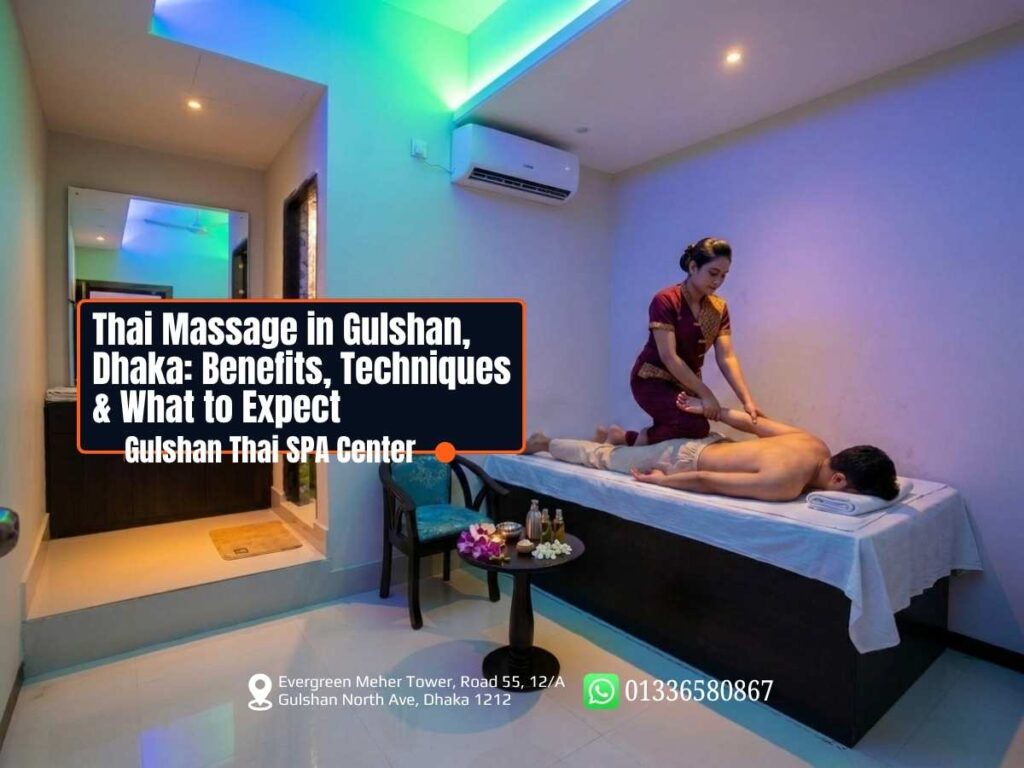
What to Expect During a Thai Massage Session in Gulshan, Dhaka
Where to Find Authentic Thai Massage in Gulshan, Dhaka
Authenticity matters here. A genuine Thai massage requires a therapist trained specifically in the technique — it’s not something that can be faked with a generic oil rubdown. Gulshan Thai SPA Center is centrally located at Evergreen Meher Tower, 12/A, Road 55, Gulshan North Avenue, Gulshan 2, Dhaka 1212 — an easy, central location for clients across Gulshan, Banani, Baridhara, and Uttara. We’ve served over 2,000 clients since 2018 and hold a 4.9★ Google rating, with therapists trained specifically in traditional Thai technique — not a generalized “everything” massage menu learned from a manual.
Preparing for Your Thai Massage Appointment
Booking ahead is easy — we take reservations by phone and WhatsApp, and walk-ins are always welcome if you’d rather decide on the spot. When you call 01336-580867, mention any specific areas of tension (a stiff neck, tight hips, lower-back pain) so we can match you with the right therapist and technique for your body.
Typical Session Duration and Costs
Most Thai massage sessions run 60 or 90 minutes, giving your therapist enough time to work through the full sequence of stretches and pressure points without rushing. Pricing at our Gulshan location is transparent and listed upfront — no surprises at checkout. As a general guide, a 60-minute traditional Thai massage starts at a mid-range price point, with 90-minute sessions available for those who want a deeper, more thorough treatment. You can see our full, up-to-date spa prices list here. First-time clients also receive 25% off their initial visit.
Etiquette and What to Wear for a Thai Massage
This is one of the most common questions we get, so let’s settle it clearly: you don’t need to bring anything special. We provide loose, comfortable clothing designed specifically for Thai massage, so you can move freely through every stretch without restriction. Simply arrive in whatever you’re already wearing, change into the provided outfit in your private room, and leave your day clothes safely stored until your session ends.
A few small etiquette notes that make the experience smoother for everyone:
- Turn your phone to silent (or leave it in your bag) so you can fully switch off for the hour.
- Speak up early if a stretch or pressure point feels too intense — a good therapist wants that feedback, not silence.
- Avoid alcohol immediately before your session, as it can affect how your body responds to deep stretching.
Feedback and Adjustments During Your Session
Thai massage is not a one-size-fits-all treatment, and it shouldn’t feel that way. Your therapist will check in throughout the session — asking about pressure, pausing before deeper stretches, and adjusting based on how your body responds. If something feels too firm, too fast, or simply uncomfortable, saying so isn’t an interruption — it’s exactly how the session is meant to work. The goal is always a treatment that matches your body, not a fixed routine applied regardless of how you’re feeling.
By the end, most clients describe a distinct, pleasant heaviness — a kind of loose, grounded calm that settles in over the following hour. Many say they sleep unusually well that night, and that stiffness they’d stopped noticing (because it had become normal) is simply gone the next morning.
Choosing the Right Thai Massage Center in Dhaka
Top-Rated Thai Massage Studios in Gulshan
Not every spa advertising “Thai massage” in Dhaka is staffed by therapists actually trained in the technique. When comparing options in Gulshan, look for a studio that:
- Specifically trains therapists in traditional Thai method, not just general massage
- Has a strong, verifiable local reputation (real reviews, real ratings, real history)
- Operates from a fixed, professional location — not a pop-up or unlisted address
- Offers transparent pricing you can see before you book
Gulshan Thai SPA Center was built around these exact standards — we’re proud to be one of Gulshan 2’s highest-rated massage spas, trusted by clients across Gulshan, Banani, Baridhara, Uttara, Mohakhali, and Niketan.
Reading Reviews and Customer Testimonials
Before booking anywhere, a quick look at recent Google reviews tells you a lot — how consistent the service is, whether hygiene is taken seriously, and whether therapists genuinely listen to feedback during sessions. Our 4.9★ rating from 50+ Google reviews reflects years of consistent, careful work, and we’d genuinely encourage you to read through them before your first visit — real client experiences say more than any marketing copy can.
Checking the Credentials of Thai Massage Therapists
Ask directly: is this therapist trained specifically in Thai technique, or generally in massage? At Gulshan Thai SPA Center, every therapist is certified and specifically trained in authentic Thai methods, so you’re getting the real technique — proper stretching sequences, correct pressure-point placement, and the pacing that makes Thai massage genuinely therapeutic rather than a rough approximation of it.
Safety and Hygiene Protocols in Massage Studios
Hygiene isn’t optional, especially for a hands-on treatment like this. A trustworthy studio should offer:
- Fully private treatment rooms, not shared or curtained-off spaces
- Fresh linens for every single client, no exceptions
- Sanitized surfaces and equipment between sessions
- Clean, freshly laundered clothing provided for each guest
These are non-negotiable standards at our Gulshan location, and it’s worth asking about them directly at any spa you’re considering.
Scheduling and Booking Your Thai Massage Appointment
Booking your session at Gulshan Thai SPA Center is simple:
- Call or WhatsApp: 01336-580867 (available 24/7 for booking)
- Walk in: We welcome walk-ins during our daily hours, 10:00 AM – 10:00 PM
- First-time client offer: New clients receive 25% off their first visit
- Location: Evergreen Meher Tower, 12/A, Road 55, Gulshan North Avenue, Gulshan 2, Dhaka 1212 — also easily reachable from Banani
Whether you’re booking your very first Thai massage or you’re a regular looking to fit in a session between meetings, we keep the process quick so you can spend your energy on relaxing, not on logistics.
Final Thoughts
Thai massage is one of the few treatments that works on your body and your mind at the same time — loosening tight muscles, restoring flexibility, and quieting a busy head, all in a single session. If you’ve been putting off doing something about that persistent tension in your neck or lower back, there’s rarely a wrong time to start.
At Gulshan Thai SPA Center, we’ve built our reputation over years of consistent, genuinely caring service — 2,000+ clients, a 4.9★ Google rating, and a team trained specifically in traditional Thai technique. Come as you are, wear whatever’s comfortable, and let us take care of the rest.
Ready to book your Thai massage in Gulshan? Call or WhatsApp us at 01336-580867, or walk in any day between 10:00 AM and 10:00 PM. First-time clients enjoy 25% off.
Frequently Asked Questions
Thai massage involves firm pressure and deep stretching, so it can feel intense at points — but it should never be sharply painful. A good therapist works within your comfort level and adjusts immediately if something feels like too much. Speaking up during your session is always welcome.
For general stress relief, once or twice a month is a good starting rhythm. If you’re managing chronic tension, tightness from a desk job, or recovering flexibility after an injury, weekly sessions for the first few weeks tend to produce the most noticeable, lasting results.
Nothing special — just arrive in comfortable clothes. Loose, breathable garments are provided at the spa for the treatment itself, so there’s no need to bring or buy anything specific.
Traditional Thai massage’s deep stretching isn’t generally recommended during pregnancy without a specially trained prenatal therapist. If you’re expecting, mention this when booking so our team can recommend a gentler, pregnancy-safe alternative instead.
Regular oil massage is typically passive — you lie still while the therapist works on you using oil and gliding strokes. Thai massage is active and assisted: you stay clothed, and the therapist physically guides your body through yoga-like stretches combined with pressure-point work, making it a more full-body, engaging treatment overall.


