
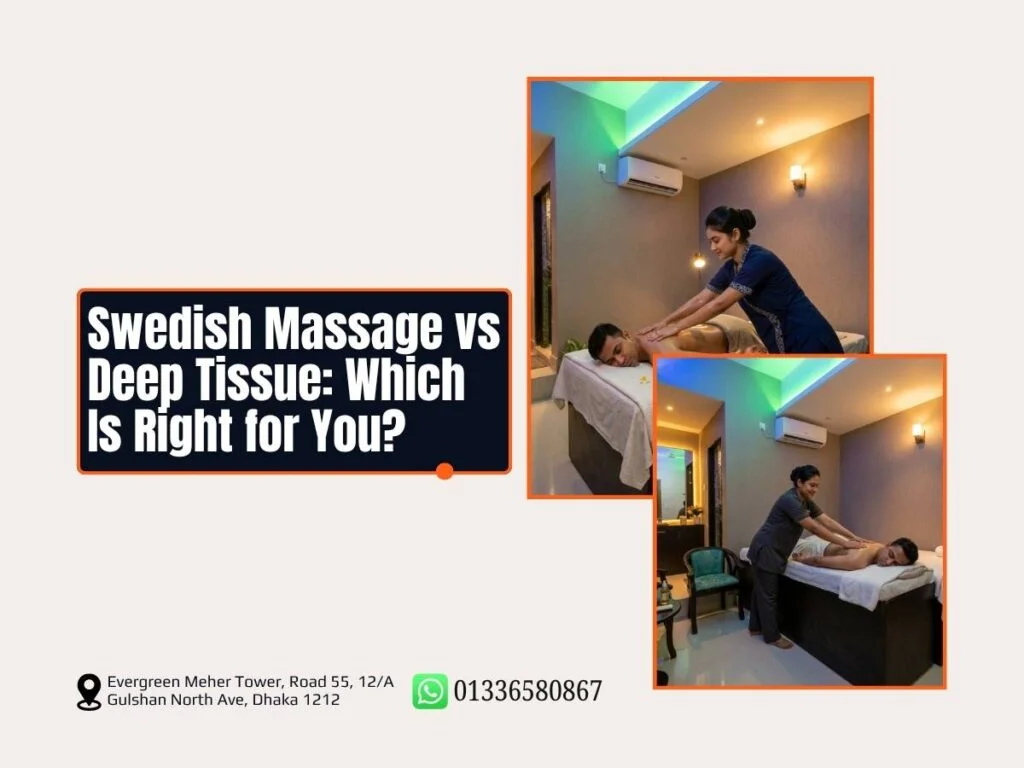
You finally decided to book a massage. Good for you – your shoulders have been asking for this for weeks. But the moment you open the booking page, you hit a wall: Swedish massage or deep tissue massage? Which one do you actually need?
If you’ve typed “Swedish massage vs deep tissue” into Google more than once this week, you’re not alone. It’s one of the most common questions new clients ask at Gulshan Thai SPA Center. It sounds simple until you realize both options promise to make you feel better — just in completely different ways.
Living and working in Gulshan, Banani, Baridhara, or anywhere else in Dhaka brings its own physical wear and tear. Long commutes, hours hunched over a laptop, back-to-back meetings, humid weather that makes everything feel heavier by 4 p.m. – it all settles somewhere in the body, usually the neck, shoulders, and lower back. The question isn’t really “which massage is better.” It’s “which one matches what my body is dealing with right now.”
Swedish Massage vs Deep Tissue – Understanding the Key Differences
Here’s the good news: there’s no wrong answer, and this isn’t a competition with a winner. Swedish massage and deep tissue massage are simply built for different bodies, different moods, and different goals. Some days you need to float out of a session feeling like jelly. Other days you need someone to dig into that knot in your shoulder blade that’s been sitting there since March.
This guide walks through what each style involves, who benefits most from each one, and how to make your own decision based on your body, your mood, and what you want to walk out feeling. We’ll also cover safety basics, clear up common myths, and finish with a side-by-side comparison you can refer back to whenever you’re booking.
By the end, you’ll know which one fits you right now — and probably which one you’ll want next time too. Most regular massage clients use both, depending on the week they’re having.
What Is Swedish Massage?
Swedish massage is the style most people picture when they imagine “going for a massage.” It’s smooth, flowing, and built around long, gliding strokes that move in the direction of blood returning to the heart.
A typical session blends a few core techniques: effleurage (long sweeping strokes), petrissage (kneading and gently lifting the muscle), light friction (warming the muscle by rubbing across the fibers), and tapotement (soft rhythmic tapping). The pressure stays light to medium through most of the session. You can fully relax instead of bracing for the next stroke.
The technique traces back to 19th-century Scandinavian roots in physical therapy and movement science. Over time, it became the relaxation-focused method practiced in spas around the world today. The intention was never to “fix” anything specific. It was to calm the nervous system, support healthy circulation, and help the body fully let go.
During a session, you stay comfortably draped throughout, with only the area being worked on exposed — a standard professional practice that keeps things respectful and focused on therapeutic relaxation. A warm massage oil or cream helps the strokes glide smoothly without dragging on the skin.
If this is your first massage ever, Swedish is almost always the gentler entry point. There’s no deep digging, no pressure that makes you gasp, and usually no soreness the next morning. It’s the massage equivalent of a long, slow exhale.
What Is Deep Tissue Massage?
Deep tissue massage looks similar on the surface — same table, same trained hands, same quiet room — but the intention is completely different. Instead of gliding lightly over the muscle, the therapist works slowly and deliberately into the deeper layers of muscle tissue and the connective tissue (fascia) surrounding it.
The strokes are firmer, slower, and far more focused. Rather than covering the whole body evenly, a deep tissue session often spends extra time on specific trouble spots: a stiff lower back, tight hip flexors from sitting all day, or shoulders that have quietly carried stress for months. Therapists use their fingers, knuckles, and sometimes forearms to reach the muscle layers that lighter pressure can’t access.
This style of bodywork grew out of decades of clinical and sports-massage practice. It was designed specifically for chronic tension, old injuries, and the muscle adhesions — commonly called “knots” — that build up from repetitive movement or poor posture over time.
Mild soreness for a day afterward is common. Many clients describe it as a “good hurt,” similar to how muscles feel the day after a solid workout. That’s not a sign anything went wrong — it’s your body responding to deeper, more concentrated work. Open communication with your therapist about your pressure tolerance is a normal part of the process. That communication is what separates a deep tissue session that feels effective from one that feels like too much.
Benefits of Swedish Massage
Swedish massage earns its popularity honestly. Even though it’s gentle, its effects tend to reach further than most first-timers expect.
Stress and anxiety relief. The slow, rhythmic strokes help shift your nervous system out of “fight or flight” and into a calmer state — which is exactly why so many clients drift off halfway through the session.
Improved circulation. The strokes follow blood flow back toward the heart, which many people feel afterward as a warm, light, almost tingling sensation in their arms and legs.
Better sleep quality. This is one of the most common pieces of feedback heard — the night after a Swedish massage is often one of the better nights of sleep someone has had in weeks.
Gentle relief for everyday tension. You don’t need a chronic injury to benefit. Tired muscles from a long work week, a flight, or hours at a desk all respond well to this lighter, full-body approach.
A genuine mental reset. Beyond the physical side, there’s real value in an hour where your phone is somewhere else, your inbox doesn’t exist, and your only job is to breathe.
A comfortable starting point. Because the pressure stays moderate throughout, Swedish massage suits people who are sensitive to touch, completely new to massage therapy, or simply unsure how their body will respond to bodywork.
If your goal walking in is “I just want to feel human again,” Swedish massage is almost always the right door to walk through.
Benefits of Deep Tissue Massage
Deep tissue massage works best for people carrying something more specific than everyday tiredness — chronic tightness, old injuries, or muscles that never seem to fully relax no matter how much rest they get.
Targeted relief from chronic tension. Lower back pain, stiff necks, and tight shoulders from long hours at a desk often respond better to focused, sustained pressure than to lighter strokes alone.
Breaking down knots and adhesions. Repetitive movement and poor posture create small, tight bands of tissue under the skin over time. Deep tissue work gradually releases them.
Support for active lifestyles. People who train regularly, play sports, or stay physically active often use deep tissue massage to support muscle recovery and stay limber between sessions.
Improved mobility and range of motion. When muscles are chronically tight, joints can’t move through their full range. Loosening that tissue makes everyday movement — bending, reaching, turning your neck — noticeably easier.
Pairs well with other care. Many clients use deep tissue massage alongside guidance from a physiotherapist or doctor as part of a broader approach to managing ongoing muscular discomfort.
Relief that tends to last. Because the work happens at a deeper level, results often last longer than a purely relaxation-focused session, especially with consistent visits over time.
If you’ve been pointing at a specific spot and saying “right there, that’s the problem,” deep tissue massage is usually what your body is asking for.
Key Differences Between Swedish and Deep Tissue Massage
On paper, the two styles can sound similar — both involve trained hands, a table, and dedicated time for your body. But once you’re actually lying there, the experience feels distinctly different.
Pressure is the biggest difference. Swedish massage stays light to medium throughout, prioritizing comfort over intensity. Deep tissue massage uses firm, sustained pressure that reaches well below the surface. It should never feel sharply painful, but it will feel noticeably stronger.
Pace and rhythm differ too. Swedish massage flows continuously, moving across the body in long, connected strokes that rarely pause. Deep tissue massage moves slower and more deliberately, often lingering in one spot until the tension underneath starts to soften.
Coverage area is another factor. A Swedish session typically treats the whole body fairly evenly. A deep tissue session is usually more targeted, spending extra time on one or two problem areas rather than spreading attention equally everywhere.
The goal behind each style is different. Swedish massage is about relaxation, circulation, and a full-body reset. Deep tissue massage is about resolving something specific — chronic tightness, an old injury, or muscular tension that’s built up over weeks or months.
The after-effects aren’t the same either. Most people leave a Swedish massage feeling immediately light and loose, with little to no soreness. Deep tissue massage can leave mild soreness for a day, similar to post-workout muscle fatigue, before the deeper relief sets in.
When you put it all together, the real Swedish massage vs deep tissue decision was never about which technique is “better.” It’s about which one matches what your body needs today.
Common Myths About Swedish and Deep Tissue Massage
A lot of hesitation around booking a massage comes from ideas that simply aren’t true. Here are a few worth clearing up.
Myth: Deep tissue massage has to hurt to work. It should feel firm and focused, not sharply painful. If something genuinely hurts, tell your therapist — don’t push through it.
Myth: Swedish massage is “just relaxation” with no real benefit. Calming the nervous system, supporting circulation, and improving sleep are real, physical effects. They don’t disappear the moment you stand up.
Myth: More pressure always means a better massage. The right pressure depends entirely on your body and your goal that day. Firmer isn’t automatically more effective. It’s only effective when it matches what your muscles actually need.
Myth: You have to pick one style and stick with it forever. Plenty of people alternate between Swedish and deep tissue massage depending on how their body and week have gone. Switching it up session to session is completely fine.
Is Massage Safe for You?
Both Swedish and deep tissue massage are safe, well-established wellness practices for most healthy adults. That said, a little honesty with your therapist before the session goes a long way.
Mention it if you’re pregnant, have recently had surgery, or are recovering from an injury. Let them know if you have a skin condition or are dealing with a fever or active illness. Your therapist can then adjust the technique, pressure, and focus areas accordingly. If you have a circulatory condition, blood clotting disorder, or take blood-thinning medication, mention this before a deep tissue session in particular — firmer pressure is more intense than lighter Swedish strokes.
None of this should alarm you. For the vast majority of people, both styles are simply a safe, effective form of self-care. When in doubt, a quick word with your doctor and an honest conversation with your therapist is all it takes to choose the right approach for your situation.
How to Decide: Matching the Massage to Your Body, Mood, and Goal
This is really the heart of the Swedish massage vs deep tissue question. The answer isn’t found in a textbook. It’s found by being honest with yourself about three things: how your body feels, what kind of mood you’re in, and what you actually want out of the next hour.
Start With Your Body
Are you dealing with general stiffness, or one specific recurring problem area? Everyday tiredness, tension from travel, or sensitivity to strong pressure all point toward Swedish massage. A stubborn knot, a chronically tight lower back, or muscle tightness that hasn’t budged in weeks points toward deep tissue.
Check Your Mood
Some days you want to be looked after softly and slowly, with nothing required of you but to breathe. That’s a Swedish day. Other days you want to feel like something actually happened — like the knot is finally gone and you can turn your neck without thinking about it. That’s a deep tissue day.
Get Clear on Your Goal
If your goal is to relax and feel calmer, Swedish massage is usually the better choice. For stubborn knots or specific areas of tension, deep tissue massage is more effective. Still unsure? That’s completely normal. A professional therapist can assess your needs and recommend the most suitable treatment once you arrive.
A quick self-check:
Choose Swedish massage if: you’re new to massage, feeling generally stressed, sensitive to pressure, or simply want to unwind after a long week.
Choose deep tissue massage if: you have a specific area of chronic tension, stay physically active, sit at a desk most of the day, or want longer-lasting relief from muscular tightness.
Still unsure? Just tell your therapist what’s going on in your body. A skilled therapist can blend both approaches in a single session — starting with Swedish to warm up the muscles, then easing into deeper work where it’s needed.
What to Expect When You Book With Gulshan Thai SPA Center
Knowing the theory behind Swedish massage vs deep tissue is useful. But the actual experience depends heavily on who’s doing the work. Choosing the right spa matters just as much as choosing the right technique.
At Gulshan Thai SPA Center, every session — Swedish, deep tissue, or a blend of both — starts with a short conversation. Our certified massage therapists ask about your problem areas, your pressure preference, and what you’re hoping to get out of the session before you ever lie down. That conversation turns a generic massage into the right massage for your body on that particular day.
We’ve built our reputation in Gulshan 2, Dhaka over thousands of sessions. We currently hold a 4.9-star rating from more than 2,000 clients across Gulshan 1, Gulshan 2, Banani, Baridhara, Uttara, Dhanmondi, and the wider Dhaka area. That track record matters to us — it comes from consistent, professional care delivered the same careful way, every single visit.
Our Treatment Rooms and Services
Every treatment room is private and maintained to a high standard of hygiene, because feeling genuinely comfortable is non-negotiable for real relaxation to happen. Alongside Swedish and deep tissue massage therapy, we also offer Traditional Thai Massage, Aromatherapy Massage, Hot Stone Massage, and Full Body Scrub. If what your body needs changes from one visit to the next, you have options without needing to find a new spa.
We’re open daily from 10:00 AM to 10:00 PM. Walk-ins are always welcome. You can book by phone any time at 01336-580867. First-time clients receive 25% off their first visit — a low-pressure way to try whichever style sounds right for where your body is right now.
Swedish Massage vs Deep Tissue: Side-by-Side Comparison
If you only remember one section from this entire guide, make it this one.
| Factor | Swedish Massage | Deep Tissue Massage |
|---|---|---|
| Pressure level | Light to medium | Firm to deep |
| Pace | Smooth, continuous strokes | Slow, deliberate, focused |
| Coverage | Full body, evenly distributed | Targeted problem areas |
| Best for | Relaxation, stress relief, first-timers | Chronic tension, knots, muscle recovery |
| Sensation during session | Calming, gentle | Strong, occasionally intense |
| Soreness afterward | Rare to none | Possible mild soreness for a day |
| Ideal mood | “I want to unwind” | “I want this fixed” |
| Common goal | Mental and physical relaxation | Longer-lasting muscular relief |
| Good as a first massage? | Yes | Better after some massage experience |
| Pairs well with | Aromatherapy, hot stone massage | Active lifestyles, desk-job recovery |
Bookmark this table. Next time you’re staring at a booking page wondering “Swedish massage vs deep tissue — which one do I actually pick,” this is your answer key.
Frequently Asked Questions
Swedish massage is generally the better choice for pure stress relief. Its slow, rhythmic strokes calm the nervous system and encourage deep relaxation throughout the body. Deep tissue massage can still reduce stress as a side effect of relieving physical tension, but it primarily targets specific muscular problems rather than overall calm.
Mild soreness for 24 to 48 hours is common and completely normal, especially after your first deep tissue session or if a particularly tight area was worked on. It typically feels similar to muscle fatigue after a workout and fades on its own. Drinking water and light stretching afterward can help it pass more comfortably.
Speak up before the session starts, and again during it if needed. A good therapist checks in throughout and adjusts based on your feedback. There’s no need to guess or quietly push through discomfort. If you’re unsure where to start, ask for medium pressure and let your therapist know if you’d like it firmer or lighter as the session goes on.
Can I combine Swedish and deep tissue techniques in one session?
Yes, and it’s actually quite common. A typical approach starts with Swedish-style strokes to warm up the muscles, then shifts into deep tissue work on specific tight areas once the body has relaxed. Just mention to your therapist that you’re open to a blended approach when you book.
How often should I get a massage for the best results?
For general relaxation, once or twice a month suits most people well. For chronic tension or recovery from regular physical activity, weekly or biweekly deep tissue sessions tend to produce more noticeable, longer-lasting results. Your therapist can suggest a schedule based on what your body is actually dealing with.
Final Thoughts: There’s No Wrong Choice Here
The truth about Swedish massage vs deep tissue is that it was never really a competition. One is built to help you relax. The other is built to help you recover. Plenty of people end up loving both and switch between them depending on the week they’re having — and that’s exactly how it’s meant to work.
If you’re still not sure, that’s completely fine. Walk in, tell your therapist how you’re feeling, and let a trained professional guide the rest. That’s exactly what we’re here for at Gulshan Thai SPA Center.
We’re located in Gulshan 2, Dhaka, and welcome clients from across Gulshan 1, Banani, Baridhara, Uttara, Dhanmondi, and the rest of the city. We’re open daily from 10:00 AM to 10:00 PM, with walk-ins always welcome. Call or book any time at 01336-580867. First-time visitors get 25% off — which makes trying it out an easy decision.
Whichever one you choose today, your body will thank you for booking either.


